Event Info
Organized By
Arabia Circular Hub Helsinki (Business Helsinki & Forum Virium Helsinki)
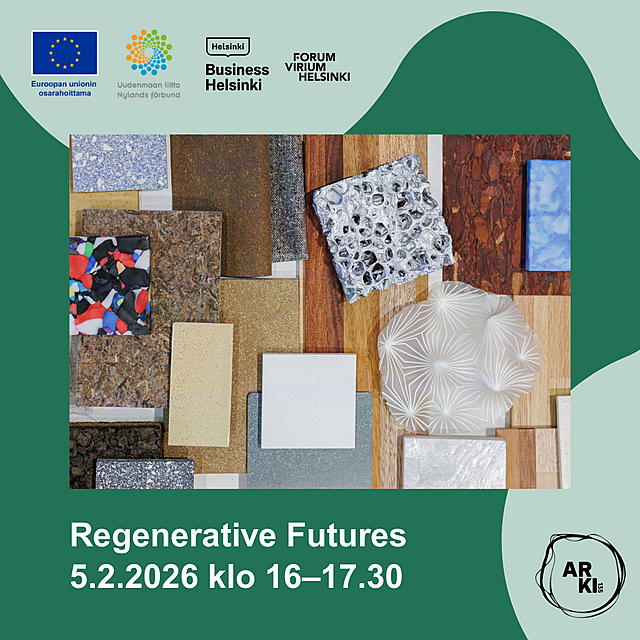
Regenerative Futures @ ARKI 135
Vesa Laitinen / Helsinki Circular Economy Cluster
Join the exhibition opening to hear about bio-based material innovations and regenerative design!
Opening during the Finnish Architecture and Design Days, the Regenerative Futures exhibition invites visitors to explore new possibilities for our built environment: what regenerative solutions could emerge from mycelium, algae, or other nature-inspired innovations?
A regenerative approach can also reach beyond materials and products, expanding its influence to wider systems like urban planning. On Thursday, February 5, the opening event at ARKI 135 Circular Hub will feature insights from experts on how regenerative materials and supporting nature’s processes can drive sustainable design and the responsible use of natural resources.
In the exhibition, companies and researchers showcase unexpected perspectives on nature‑based material innovations and the value hidden in underutilised resources. The exhibition features Caracara Collective, University of Helsinki, Mattia Anderle/Aalto University, Lovia & Brightplus, NEMO architects, Johanna Hyrkäs/Aalto University, Ecococon, UKU and Myceen.
Check out the programme and sign up on the event page. The exhibition is organised as a part of the Arabia Circular Hub Helsinki project, co-funded by the European Union.
Accessibility
Two accessible parking spaces are located outdoors, more than 10 meters from the entrance A. The width of the parking spaces is less than 3.6 meters. The route to the entrance of is level, sufficiently wide, and well-lit. The route includes a ramp over 6 meters long without an intermediate landing.
Access to the ARKI 135 Circular Hub is through the entrance A, using the elevator to the fourth floor. The elevator is accessible: door width 90 cm, height 200 cm, depth 135 cm. The corridor from the elevator to the hub entrance is wide and unobstructed. The hub entrance is moderately distinguishable from the glass wall and is well-lit. The entrance door is clearly visible and has contrast markings on the glass. The door opens manually, and there is sufficient space in front for maneuvering with a wheelchair, for example. There are no thresholds at the entrance.
The space does not have an accessible restroom. The nearest accessible restroom is on the second floor. The accessible restroom provides at least 80 cm of free space on both sides of the toilet. Support rails are attached to the toilet seat.
