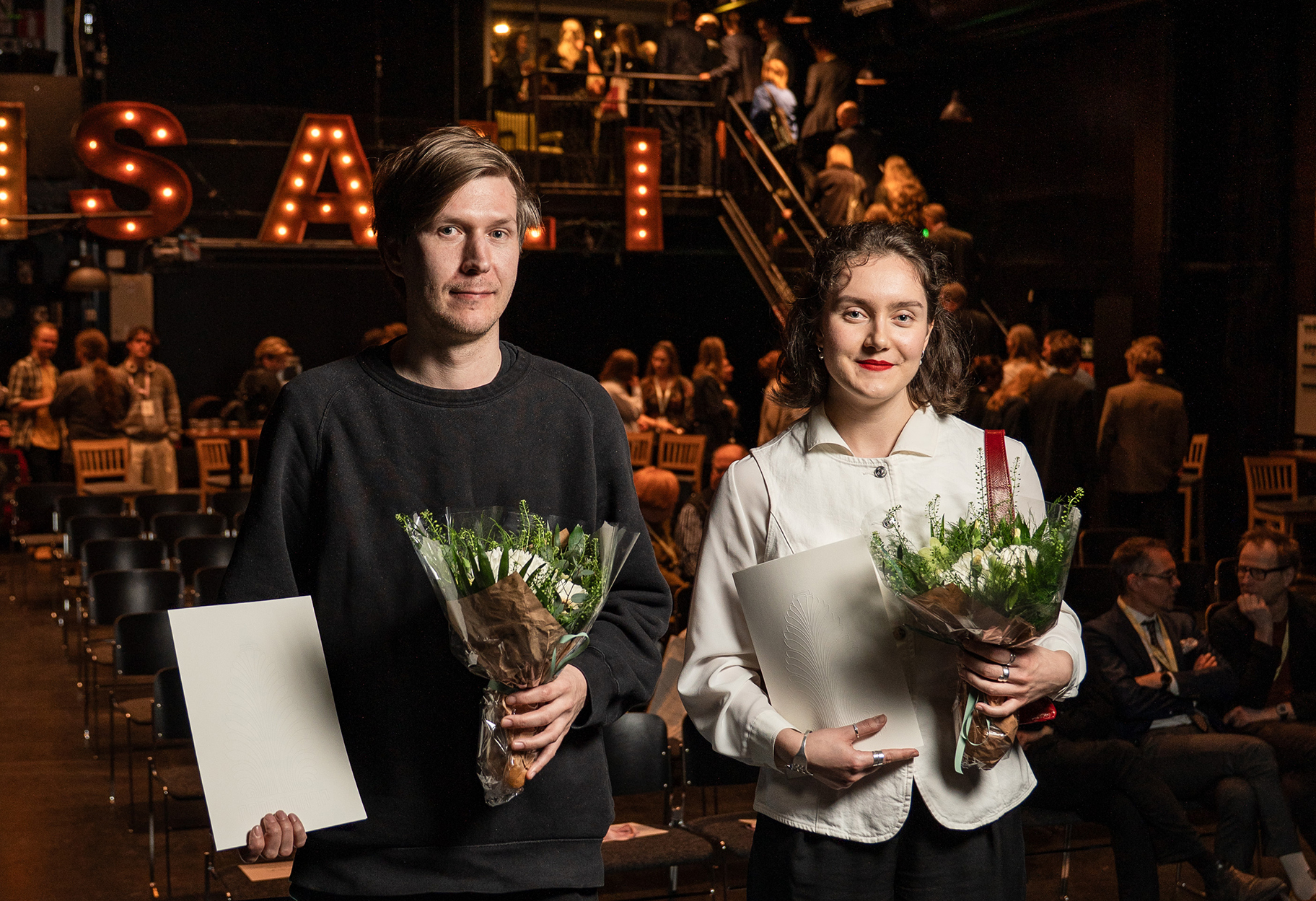
“A building does not have an expiration date” – architect Eveliina Sarapää awarded a thesis that proposes an alternative to demolition

Tuukka Uimonen / SAFA
The Finnish Association of Architects presented the Wuorio Prize for the best master’s thesis in architecture in April in Oulu. This year, the finalists and the winner were selected by architect Eveliina Sarapää, who evaluated the works through the lens of her own values rooted in Sámi culture. In her text based on the award speech, she also reflects on issues specific to the North.
I had the honor of selecting this year’s recipient of the Wuorio Prize, the annual award for the best master’s theses in architecture. I received nine theses to review, three from each Finnish school of architecture, and all of them were excellent. Any one of them could have justified receiving the award.
I am a Sámi architect, and both my own work as an architect and this selection process are guided by certain principles that arise from Sámi tradition and culture. First: respect for what we already have. Second: the wise and ingenious use of resources. And third: an understanding of the human being as part of a larger whole.
“Because of carbon dioxide emissions, all new construction should really stop now – though that is probably not entirely possible.”
In Sámi culture, natural resources are used only as much as is needed, in a sustainable way so they can regenerate. Olivia Myntti’s thesis Nature-Based and Sustainable Viinikanlahti Central Block: Urban Housing with Straw and Timber Construction is a good example of the wise use of resources. Because of carbon dioxide emissions, all new construction should really stop now – though that is probably not entirely possible. Myntti shows us a model for how new construction should be carried out – if it must be done.
Myntti designs an adaptable block of flats from natural materials such as wood and straw with ease and confidence – as though this were how buildings had always been made. The work inevitably questions the current construction industry’s dependence on energy-intensive and multilayered materials and proposes a new direction: instead of pulp production and exporting raw timber, Finland could invest in highly refined bio-based building materials. The architectural quality of the design arises not only from the end result but from what it is made of and how it is made. Myntti’s design withstands the important questions: from whom was the material taken, where has it been, and where can it continue on to?
“Nature is not an asset to be owned, but a relationship in which humans are participants.”
The Sámi worldview includes reciprocity with nature: the strength of nature is part of human strength, and the well-being of both depends on the balance between the human and nature.
Outi Lassila’s thesis Mixed Blocks of Urban Life and Nature: supporting biodiversity in the built environment challenges the anthropocentrism of Western architecture and introduces a design perspective in which non-human species also have a right to space and habitat. Human beings are part of a broader living whole, not above it. Lassila highlights a planning method based on advocacy for other species. This is not merely theory. For example, in New Zealand the Whanganui River was granted legal personhood, and “solicitors” were appointed to act on behalf of the river. Behind this lies the Indigenous view of the river as a living actor rather than a resource.
Nature is not an asset to be owned, but a relationship in which humans are participants. Lassila’s work successfully combines a theoretical framework with practical applicability in design and offers a significant contribution toward transforming our relationship with all living things around us.
“Demolition is not a technical or functional necessity but rather the result of economic and zoning structures.”
For me, as a Sámi architect, repair is not merely a construction-technological operation but a way of entering into a responsible relationship with land, materials, and time. A building is a material continuum whose value grows through use and transformation.
A building does not have an expiration date. On this, I am certain that Heikki Myllyniemi and I agree. In his thesis Such Good Concrete – A plan for preserving Alppitalo building and infill construction on Karjalankatu street, Myllyniemi questions demolition by default and demonstrates that demolition is not primarily a technical or functional necessity but rather the result of economic and zoning structures that favour increasing building rights and new construction. At the same time, this disregards the materials, carbon, and cultural values already embodied in existing buildings.
When there are more than one million square metres of vacant office space in Helsinki, the city’s spatial issues no longer appear primarily as a need for new buildings, but rather as a question of the ability to use and adapt the building stock that already exists and commitment to reducing carbon dioxide emissions. Myllyniemi’s work combines critical thinking with concrete design solutions and shows that renovation and adaptive reuse should be the primary forms of architecture.
“Instead of building new, we must learn to use and respect what we already have.”
Architecture can no longer be based on the continuous consumption of natural resources. The mankind must recognise their place as part of a larger whole, the limitedness of materials, and the value of the existing environment.
I chose as this year’s Wuorio Prize winner the thesis that contains a weighty, timely, and justified critique of demolition. The work raises concern about the buildings of the 1960s–1980s, which make up a large portion of our building stock. They are reaching the age of major renovation and have no legislative protection whatsoever from demolition.
Heikki Myllyniemi’s work also questions the current guidelines used for carbon footprint calculations and life-cycle assessments comparing demolition and new construction. Their looseness makes it possible to manipulate the results, particularly to justify new construction. Utilising the existing building stock is a key solution in terms of climate emissions and resource use, and instead of building new, we must learn to use and respect what we already have.
Myllyniemi’s work is well argued and especially timely in cities such as Oulu, which could take responsibility as a model city for northern Finland and put an end to “disposable architecture,” meaning demolition-driven redevelopment. Could also the Oulu University School of Architecture give renovation architecture a bigger role in its teaching?
Geopolitical interest in Arctic regions, the contradictions of the green transition in relation to Europe’s only Indigenous people, growing pressures from tourism and housing construction farther and farther north, and the severe cross-border impacts of climate change in Sápmi make the special issues of the northern environment increasingly important. Principles rooted in the Sámi worldview – respect for materials, ingenious and ethical use of resources, practicality, storytelling, and the equality of all living beings alongside humans – would provide strong reasons to redirect the gaze and reconsider the responsibilities of Europe’s northernmost architecture school in relation to the North.
Eveliina Sarapää is a Sámi architect whose work focuses on preserving existing buildings through repair and reuse. In her current projects, Sarapää explores what Sámi contemporary architecture is or could be, how it carries cultural traditions through time, and what answers Indigenous ways of thinking can offer to contemporary construction, which must change. Sarapää is the founder of Sarapää Oroza Hartiala Architects.
The 2026 Wuorio Prize was awarded to Heikki Myllyniemi, a graduate of Aalto University, for his thesis Such Good Concrete – A plan for preserving Alppitalo building and infill construction on Karjalankatu street. Read Myllyniemi’s presentation of his work via this link.
Read about prize finalist Olivia Myntti’s thesis Nature-Based and Sustainable Viinikanlahti Central Block: Urban Housing with Straw and Timber Construction from Tampere University via this link.
Read about the University of Oulu-graduate finalist Outi Lassila’s thesis Mixed Blocks of Urban Life and Nature: supporting biodiversity in the built environment via this link.